Part of Something Beautiful
For the "Other Loves" series, we've asked some Headland writers about what they love to do other than writing, and how their interests feed into their writing. Adam Stone, author of The Mosaic Garden in issue 25, here reflects on the inspiration he draws from his home and garden.
Sometimes I stand in my garden and look outwards until I see inwards. I can lose an hour like that, exploring odd pathways while my feet don’t move, while the birds sing, while the sun shines, and the wind plays in the treetops or hisses quietly through the leafy branches. I’m not the type of person who can turn their mind off—I can’t sit still and meditate—but I can focus, following an idea so intently that I lose everything else, even time. It happens when I ride my bike, when I pace, when I dig, during repetitive tasks, and it happens when I lose myself in my garden.
When I’m focused like that, that’s when I write. At least, that’s when I compose what I will write later, maybe three or four hours later, maybe more. It’s also when I visualise what my garden will look like, perhaps three or four years later, maybe more. Those are my main forms of expression, and this hyperfocus is the fountain from which my creativity flows, and I love it. However, I do wonder what the neighbours think when they see me standing like a zombie in my garden, staring into the void.
In my mind’s eye, I have a simple image that you might find familiar: two parallel lines of trees border a long straight avenue. Their trunks are straight like Greek or Roman pillars, but their natural, wild branches arch to meet overhead, creating an organic cathedral, the whole thing a passage or tunnel to somewhere else. The parallel sides of the path match the symmetrical geometry of the rows of trees and act as a perfect example of Renaissance-style linear perspective, framing an infinitely distant vanishing point.
This image crops up often in various forms of art. Perhaps you have some version of it in your mind's eye now; maybe golden with autumn colours, or kimono-silk pink with blossoms; maybe lit by headlights with skeletal bare branches casting gnarled shadows as they claw at a cold, clear night sky.
In my mind, the avenue under the trees is a barefoot fantasy path, grass bordered by tall summer wildflowers, poppies, dahlias, hollyhocks, and delphiniums. I’m going to create this. The arch will be high enough to walk under but low enough to touch, and the unnatural element of symmetry will be subtly imposed. I haven’t started yet, but I will soon. This is the next big project as my garden gradually expands out from my house, like mycelium slowly spreading from a fungal spore.
The trees in my vision of the future are espaliered over an arched framework and pruned to keep the shape perfect within the structure, creating a uniformity that contrasts with the more natural growth outside the arch, where the trees reach for the sun. Inside the tunnel, I see the graceful constraint of a formal garden; outside, nature's fractal halo.
This balance between control and chaos is something I love about gardens… though the natural always wins in the end.
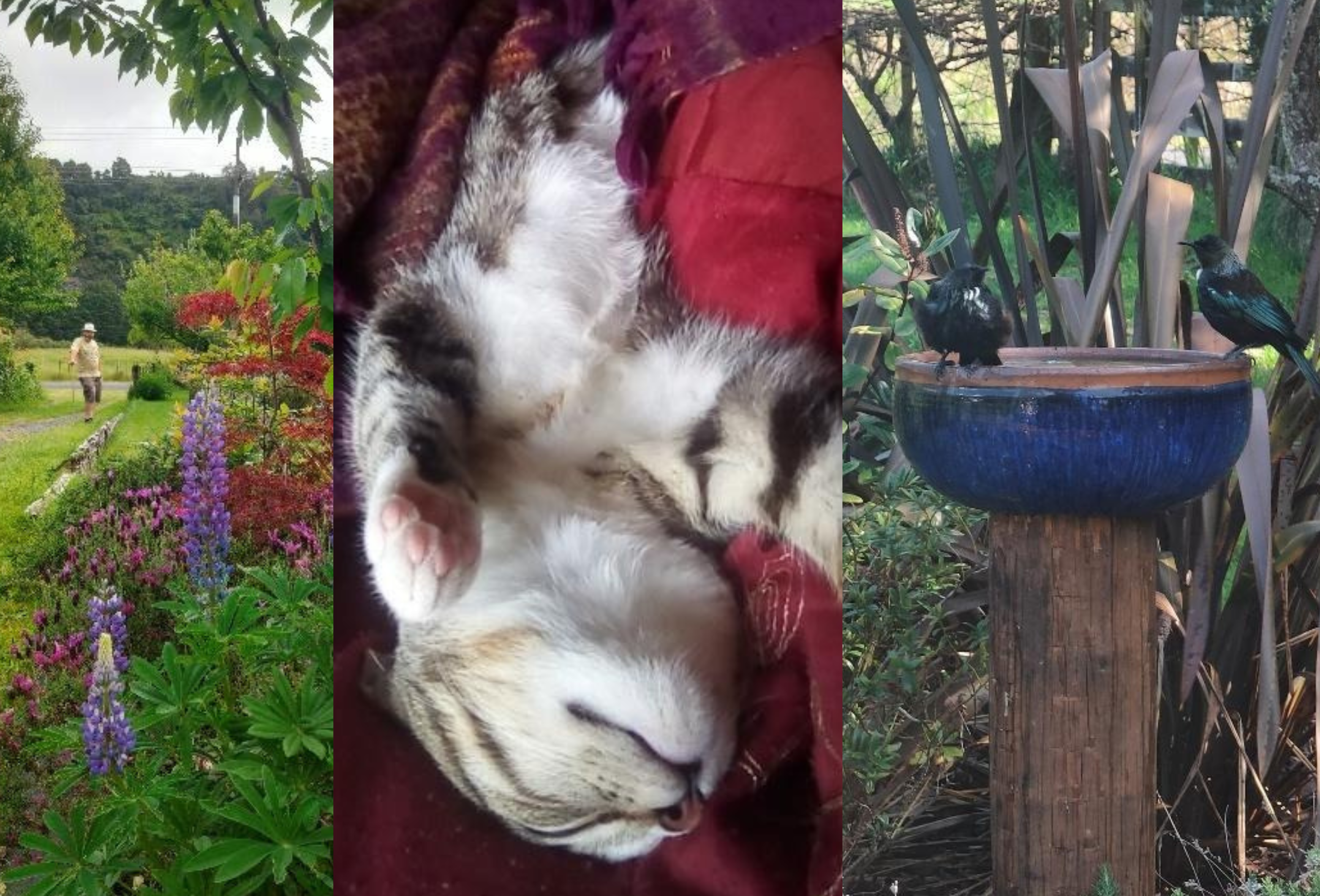
My cat’s paws smell loamy, like the soil in my vegetable patch when I’ve freshly turned it. Sometimes they smell like my compost or damp, decomposing autumn leaves—sometimes like springtime cut grass. When he’s in the mood to let me, I like to boop his paws and trace his secret adventures, discovering his hidden hollows in the garden’s sunny spots. When I wander my gardens, around and under my trees, I stumble upon the scenes of his crimes. He is careful to leave nothing but feathers and avian outrage—unless he is bringing a trophy home, which he is wont to do. During the day he is the secret observer in my botanical haven; at night he is a soft, warm friend. His purr has a whistle in it. His fur carries the aroma of the wool fadge stuffed full of hay in my greenhouse. His breath is unmentionable. His name is Monster. I love his mischievous scent.
Collaborating with nature teaches patience… and maybe also humility. I’ve been tending my garden for seventeen years. I’ve nursed it from bare land to food forest. I’m proud of what I’ve achieved, but nature will ultimately finish the job.
I’m not sure I can claim to be a humble gardener, but I am a very patient one, at peace, in fact, with the idea that the seeds I plant today may not bear fruit till after I’ve long returned to the earth myself. Any influence I impose now on the shape of my small part of the world will one day be entirely overwritten by nature’s much more enduring work. I am content to have my way now—to exist for now, as part of the garden, organic, impermanent, small, simple... but part of something beautiful.
Gardening is an art for the philosopher—an art for the reader. You can’t garden properly if you don’t occasionally sit in the sun-dappled shade under your fruit trees and read the words of great minds, while the zephyrs tease your pages. I love that.
Quails are not smart. If you stand still long enough, they forget you’re there. They scuttle around you, obliviously, peck-peck-pecking away, their little head plumes bobbing. Some birds have fantastic collective nouns—a flamboyance of flamingos, an unkindness of ravens, a parliament of owls. A covey of quail doesn’t do them justice. It doesn’t do justice to the startled explosion of grey-feathered missiles that launch into hyperspace the moment you move and they realise you’re there. I’d name them a detonation of quail if I had the job. Still, they are quick to forgive, or maybe quick to forget. If you stand still again, they soon come back, and I’m glad they do. We are known for loving our birdlife, we Kiwis. I’m no exception despite my dubious feline affiliation.
My kitchen has one window. It is a perfect rectangular frame in which a picture has grown. Beauty from shit, you might call it. The window looks out over a mandated garden, a septic-tank run-off field. The resource consent for our sewerage system demanded an area, six metres by twelve, to be isolated, barked and planted, so that humans wouldn’t walk where the wastewater was organically processed. I don’t generally like rectangular gardens, but we made this one work; we had no choice, and as it turned out, the plants love the moist, nutrient-rich location. It is one of our most lush plantings. It has been six years, and the window now frames something beautiful.
The garden was planted out with natives mostly, every variety of hebe under the sun, flaxes—variegated or russet red—native grasses and tussocks, and for good measure a bit of good old-fashioned English rosemary and French lavender. Nestled among this is a homemade bird bath, a glazed garden pot mounted on a wooden post, cheap and effective.
Now the birds come to take their daily baths—tui, thrushes, goldfinches, sparrows, even kererū sometimes.
We don’t have heaps of money, my wife and I, but there is a picture I love framed on our kitchen wall that you couldn’t pay me a million dollars for.
It’s not work if you love doing it. I write. I garden. I read. I teach. I watch. I learn. None of this is work.


